
This post contains affiliate links. If you click a link and make a purchase, I may earn a small commission at no extra cost to you. I only recommend products I genuinely believe in. Thank you for supporting Amoria Style!
You know the feeling. A heel that felt extraordinary in the changing room at 3pm — the height right, the colour perfect, the whole thing suddenly making your outfit look like it had a point. Then 9pm, and you’re carrying them in one hand, walking barefoot across a restaurant floor that probably shouldn’t be walked on barefoot. This is not a character flaw. It is a mismatch between what a shoe was designed to do and what you asked it to do. Every style below is reframed around closing that gap.
1. Block Heel
The block heel’s durability case is structural. The heel column is wide enough to distribute your body weight across a larger surface area, which reduces the moment arm — the torque-like force that makes narrow heels destabilising on uneven ground. What to check on the rack: whether the block sits directly under the heel bone or is set slightly forward. A heel positioned too far back relative to your natural heel strike forces your weight forward into the toe box, negating the stability benefit entirely.
Outfit equation: A block heel in the 6–7cm range visually shortens the leg less than a stiletto of the same height, because the eye reads mass as well as elevation. Pair with a straight-leg trouser that breaks at the ankle — not the floor — so the heel is visible and reads as a design choice rather than an afterthought. With a midi skirt, choose a hem that lands mid-calf; any lower and the proportions compress.


2. Stiletto
Not all stilettos are built the same, and this is where most buying decisions go wrong. The critical variable is heel placement: a stiletto with the pin set directly beneath the heel bone allows a more natural gait. One set even a centimetre forward shifts your centre of gravity and puts sustained pressure on the metatarsal heads — the bones just behind your toes — which is where the burning starts around the 90-minute mark. Look also at the steel shank running through the insole; a full-length shank provides rigidity that prevents the shoe from bending where your foot shouldn’t be bending.
Outfit equation: A stiletto lengthens the visual line of the leg, which means it works hardest when that line is uninterrupted. Avoid hemlines that cut across the mid-shin — they halve the effect. A column dress that ends just above or below the knee, in a fabric with some weight (crepe, ponte, heavy jersey), creates a continuous vertical from shoulder to floor that the heel anchors rather than punctuates.

3. Kitten Heel
The kitten heel — typically 3.5–5cm — has a reputation for being the compromise heel, which undersells it. Its real advantage is biomechanical: at this height, the pitch of the foot stays within a range that doesn’t significantly alter gait or load distribution. The toe box shape matters more here than in higher heels, because the foot isn’t being pitched forward, so all pressure is carried by the forefoot in its natural position. A narrow, pointed toe box on a kitten heel can cause more discomfort than the same shape on a stiletto, because there’s no forward lean to take weight off the widest part of the foot.
Outfit equation: The kitten heel is short enough that it reads as footwear, not architecture. It suits cropped and midi lengths well — particularly a full midi skirt in a lightweight fabric like cotton voile or silk, where the slight heel just lifts the hem off the ground and gives movement to the skirt without competing with it. With tailoring, try a slightly cropped trouser that sits above the ankle; the gap between hem and shoe is where the kitten heel does its most elegant work.

4. Mule
A mule — backless by definition — distributes load entirely across the forefoot, which is why fit at the vamp (the front strap or throat of the shoe) is more consequential than in any other heel type. Too loose and the foot slides forward on every step, jamming the toes; too tight and it creates a single pressure point across the metatarsals. Look for a vamp that holds the foot firmly without a visible indent in the skin after ten minutes of wear. Cork or memory foam footbeds make a measurable difference in mules specifically, because there’s no heel counter to stabilise the foot.
Outfit equation: The mule’s exposed heel creates a floating visual effect that works well with wide-leg and palazzo trousers — the fabric moves, the foot appears, the heel appears, the whole silhouette reads as relaxed rather than underdressed. With a dress, a hem that grazes the top of the foot tends to obscure the mule’s distinctive silhouette; keep the hem at or above mid-calf.

5. Wedge
The wedge’s functional advantage is often overstated and its limitation understated. The continuous sole from heel to toe does reduce forefoot pressure by distributing load along a larger surface — but it also removes the natural flex point of the foot, which makes the gait stiffer and increases fatigue over long distances. Look for a wedge with a slight flex groove built into the sole under the ball of the foot; this compromises the aesthetic slightly but significantly improves comfort past the two-hour mark. Cork wedges flex more naturally than rubber or dense foam.
Outfit equation: The wedge adds height without the visual delicacy of a stiletto, which means it suits casual and relaxed dressing better than formal. A wedge sandal reads as part of a summer outfit, not an elevation of one — pair it with wide-leg linen trousers or a tiered midi dress in a washed cotton. Avoid anything structured or tailored; the wedge’s silhouette works against the precision that tailoring requires.

6. Platform
A platform’s functional promise — reduced forefoot pressure by shortening the effective heel height — is only delivered when the platform is substantial enough relative to the heel. A 10cm heel with a 3cm platform gives an effective pitch of 7cm, which changes the loading considerably. Under 2cm of platform on a high heel is largely cosmetic. Check that the platform is rigid rather than squishy; a compressible platform changes height with every step and adds instability rather than subtracting it.
Outfit equation: Platforms read as statement shoes, which means the rest of the outfit needs to be quieter. A platform heel in a bold material or colour belongs with straight, minimal separates — a wide-leg trouser and a fitted top, or a slip dress in a neutral. The platform’s visual weight is at the base; balance it by keeping volume lower in the silhouette rather than above the waist.

7. Ankle Strap Heel
The ankle strap’s job is to hold the foot in place, but execution varies widely. A strap that sits directly over the ankle bone concentrates pressure on that bony prominence and creates a predictable hot spot. Straps that sit slightly lower — across the fuller part of the lower ankle — distribute load across soft tissue rather than bone. Adjustability matters: a buckle that allows you to shift by even one hole can be the difference between a strap that functions and one that marks the skin. Elasticated ankle straps are more accommodating but offer less of the load-distribution benefit.
Outfit equation: The ankle strap draws a horizontal line across the leg, which visually shortens it. This is not a flaw; it is information. With a midi skirt, the strap becomes one of several horizontal elements — hem, strap, neckline — that structure the look deliberately. With bare legs, the cut-off effect is most pronounced; if leg length is a concern, a strap in a skin-adjacent tone reduces it.

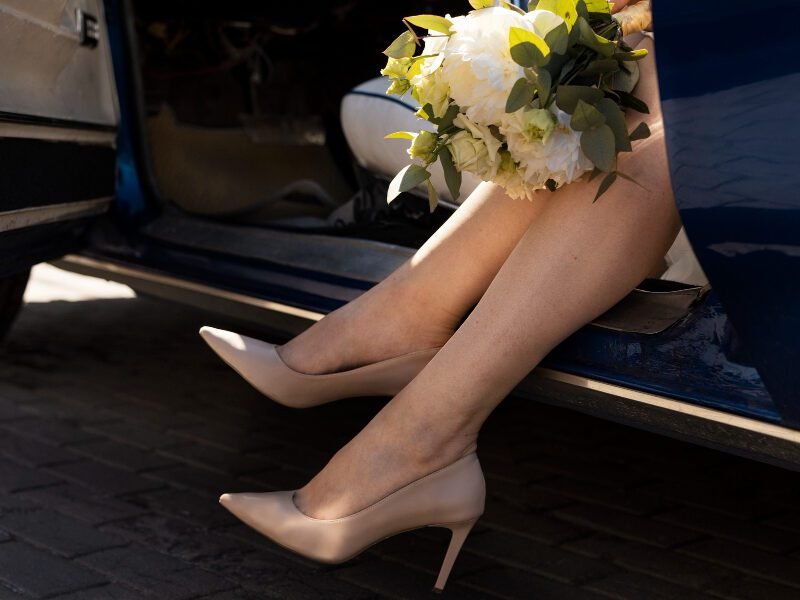
8. Pointed-Toe Pump
The pointed toe is a silhouette, not a last shape — which is the crucial distinction most buyers miss. The point can begin at the big toe joint or several centimetres beyond it, and this determines whether the shoe actually fits the foot inside it. A pump where the point extends well past the natural toe line gives the foot room to splay at its widest point while maintaining the elongated aesthetic. Squeeze the toe box gently in the shop: if there’s no give at all, there’s no room for the foot to move through a full stride.
Outfit equation: The pointed toe reads as precise and directional. It suits tailoring almost unconditionally — a trouser suit, a shift dress, a pencil skirt — because the sharp toe continues the intention of structured clothing. The visual line it creates is most effective when the hem is at or just below the knee, allowing the toe to project forward rather than disappear under fabric.

9. Slingback
The slingback’s construction challenge is the strap: it must hold the heel in place without cutting into the Achilles area, which has minimal soft tissue buffering. Look at where the strap joins the shoe — if the attachment point sits high and rigid, it will dig. Straps that have a slight curve downward at the back of the heel, following the foot’s natural contour, sit more comfortably. As with the ankle strap, elasticated slingbacks are more forgiving but provide less support.
Outfit equation: The slingback is a neater proposition than the open-back mule — the strap creates a frame that makes the shoe read as more deliberate. It works with skirt suits and tailored dresses in a way the mule doesn’t, because the closed structure matches the precision of fitted clothing. The slight exposure at the heel lightens any look; in winter dressing it provides the openness of a sandal without the impracticality.

10. Heeled Boot
Boots redistribute the functional equation entirely: the shaft takes over much of the work of holding the foot in place, removing the dependency on the sole and toe box alone. This is why a heeled boot is often more comfortable than a heeled shoe at an equivalent height — the ankle has lateral support it doesn’t get in a shoe. The key variable is shaft stiffness: a very rigid shaft prevents the natural forward lean of the ankle in gait and creates calf fatigue. A shaft with some give, in leather or stretch material, allows the foot to move through its stride.
Outfit equation: A heeled ankle boot with a straight or slightly tapered leg trouser creates a continuous line that reads as elongating only if there’s no gap between hem and boot shaft. Even 2–3cm of exposed ankle breaks the line. With a midi skirt, let the hem fall to mid-calf and the boot shaft appear below it — the visual break here is intentional rather than accidental.

11. Cone Heel
The cone heel — wider at the top, tapering toward the base — offers more surface area underfoot than a stiletto while maintaining a more refined silhouette than a block. Its stability falls between the two. Because the taper means the contact point with the floor is still relatively small, cone heels are sensitive to surface quality; they perform well on smooth floors and poorly on cobblestones or soft ground. This is useful information for event planning, not just shoe shopping.
Outfit equation: The cone heel has a sculptural quality that benefits from exposure. With a dress or skirt, a hem above the knee gives the heel room to read as a design element. Pair with something simple above — a shift, a wrap dress in a matte fabric — so the heel’s shape is the focal point at the base of the silhouette rather than competing with a busy print or volume above.

12. Strappy Sandal Heel
Multiple straps distribute and complicate load simultaneously — each strap is a potential pressure point, and the more straps, the more variables. Look for straps that lie flat against the foot without requiring extreme tightening to stay in place; a strap that needs to be pulled tight to prevent slipping will always create a mark. Adjustable buckles at multiple points are worth paying for. Footbed material matters: a leather footbed moulds to the foot over time, while synthetic materials don’t, which is why strappy sandals often improve significantly after a few wears.
Outfit equation: The strappy sandal heel is the most visually open of all the styles, which means it reads as lightest and most summery regardless of its height. It works with anything that doesn’t compete at the foot — wide-leg trousers are a difficult pairing because the trouser hides the strap detail that justifies the shoe’s complexity. The strappy heel earns its place with bare legs, a slip dress, or a skirt that ends above the knee, where the eye can actually follow the line of the straps all the way down.

The shoe that felt extraordinary in the changing room and stayed extraordinary at midnight is not a matter of luck. It is a matter of knowing which construction details to look for before the lights dim.
