
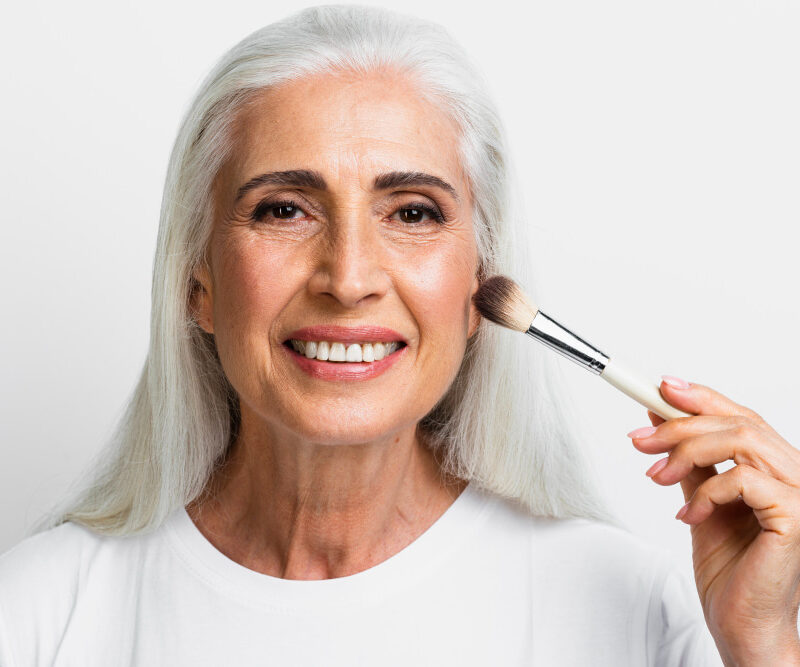
This post contains affiliate links. If you click a link and make a purchase, I may earn a small commission at no extra cost to you. I only recommend products I genuinely believe in. Thank you for supporting Amoria Style!
Most articles about makeup for older women do one of two things: they treat aging as a crisis to manage (“minimize,” “disguise,” “fight”), or they go so soft on practical content that you finish reading and have no idea what to actually buy or do differently. Neither is useful. The first is condescending. The second is a waste of your time.
You’ve been doing your makeup for thirty or forty years. You don’t need a lecture on confidence. What you might find useful is an honest explanation of what’s actually happening to your skin and why certain techniques work better now than the ones you’ve been using — because the physics of makeup on skin genuinely changes, and adjusting your approach isn’t about “aging gracefully,” it’s just about understanding the material.
That’s what this guide is.
What Actually Changes — and Why It Matters for Makeup
Before any technique makes sense, the underlying biology does. Skin in your 50s, 60s, and beyond isn’t just “older skin” in some vague sense — specific things have changed, and each one has a direct effect on how makeup behaves.
Sebum production slows significantly with age, particularly after menopause. This means skin is drier, more often, more reliably. The practical consequence for makeup isn’t just that you need moisturizer — it’s that powder products behave completely differently on dry skin than on oily or combination skin. Powder clings to dry texture. It emphasizes it. Formulas that were forgiving at 30 look chalky and flat at 55 on the same face, not because the face is worse, but because the surface chemistry changed.
Skin also becomes thinner. The dermis loses collagen and the subcutaneous fat layer beneath thins out, which means skin has less underlying structure to give it opacity. This produces more translucency — you see more of the vascular layer beneath, which can shift skin tone toward ruddiness or, conversely, a kind of grayish pallor depending on the person. It also means that foundation applied heavily looks more obviously like a mask, because the skin beneath it no longer has the plumpness to make coverage read as skin.
Volume loss happens at the level of bone and fat — the face literally changes shape, slowly. Cheekbones become more prominent in some places as the fat pads beneath them descend. The temples hollow slightly. The jawline shifts. This matters for blush placement, for highlight, for the entire logic of where you put color.
Skin texture changes too: fine lines, larger-appearing pores (not because pores actually grow, but because surrounding skin loses the firmness that kept them tight), and changes in surface smoothness. And skin tone becomes more uneven — sun damage accumulated over decades, changes in pigmentation, and changes in circulation all contribute.
Understanding this isn’t depressing — it’s just accurate. And it’s the reason every technique in this guide works the way it does.
Foundation: The Most Important Decision You'll Make
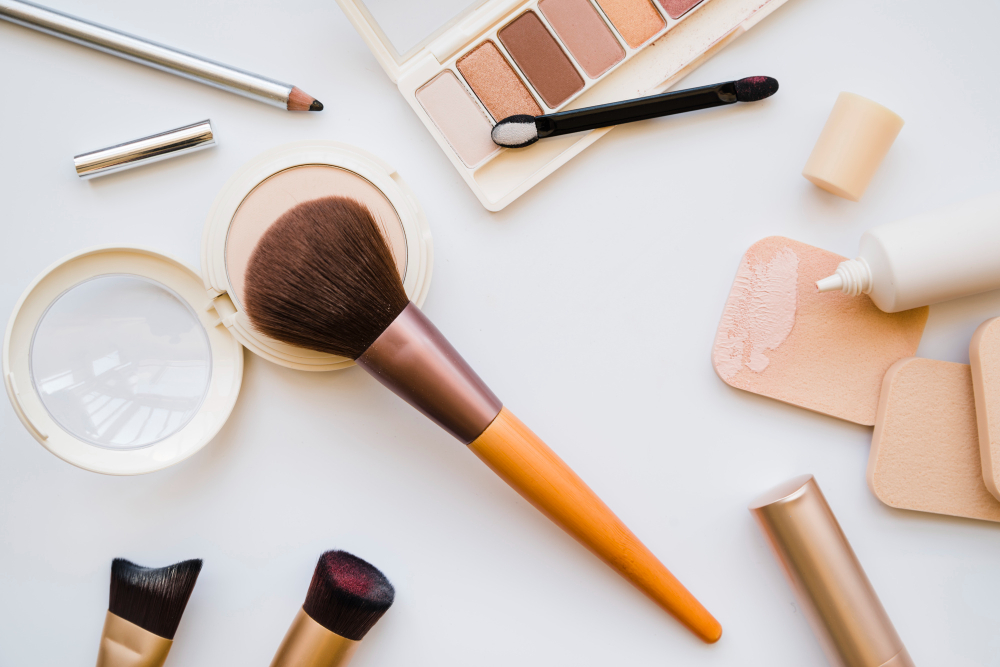
The foundation question is where most makeup mistakes for mature skin originate, and it comes down to one counterintuitive truth: more coverage doesn’t produce more coverage. On skin with fine lines and texture, a heavy full-coverage foundation doesn’t hide the skin — it coats it. The product settles into lines, accentuates pores, and sits on top of the face in a way that reads as makeup rather than skin. The physics are simple: thick product fills textured surfaces unevenly, and light catches those filled-in lines more than the lines themselves.
What actually works is a lighter, more skin-like base that unifies tone without trying to erase texture. Skin tints, tinted moisturizers, and serum foundations are worth understanding as distinct categories. Skin tints are the lightest — essentially skincare with a tiny bit of pigment, useful for even skin that just wants a little warmth and glow. Tinted moisturizers sit in the middle: real coverage, still breathable, still moveable. Serum foundations are the most sophisticated option — they’re formulated with skincare ingredients and tend to have a luminous, skin-like finish that’s hard to replicate with traditional foundation.
“Dewy” has become a slightly overloaded word in beauty, so it’s worth clarifying what it means here. Dewy skin looks hydrated and light-reflective. Greasy skin looks shiny and heavy. The difference is finish: a serum foundation or tinted moisturizer will give you the former. A face misted with setting spray over a heavy foundation gives you the latter. If you’ve tried “going dewy” and felt like you looked oily, the formula was the problem, not the direction.
Application tool matters more than most people realize. A damp beauty sponge — dampened with water, not product — applies liquid and cream base products in a way that a brush simply doesn’t. Brushes can streak, and they push product into lines. A sponge, used with a pressing and rolling motion rather than dragging, deposits product on top of skin rather than into it. It’s not a minor difference.
Where you apply foundation matters too. Most faces don’t need even, all-over coverage. The center of the face — around the nose, across the forehead, the chin — tends to be where uneven tone concentrates. The outer edges of the face, where skin is often closer to even, frequently look better with less or nothing. Going edge-to-edge with foundation can make the face look flatter and more masked. Try applying to the areas that need it and see what happens.
Setting powder is where many people over-apply out of habit. Powder should be minimal and targeted — T-zone if you need it, not the whole face. For the rest of the face, a light-reflecting setting product (not a matte one) does something different: it diffuses light rather than absorbing it, which softens the look of texture without flattening the finish. These are sometimes sold as “blurring” powders. They’re not magic, but the distinction from mattifying powder is real.
Eyes: Where Technique Changes the Most
As skin loses elasticity, the eyelid tends to become more hooded — the brow bone descends slightly, the lid space decreases. This changes almost everything about eye makeup logic.
Liner placed tight along the lash line can disappear on a hooded lid, or worse, appear only when the eyes are cast down. Moving liner slightly above the lid — or switching to a technique called “tightlining,” where liner goes between the lashes along the waterline — keeps definition visible without the disappearing act. A smudged, soft liner tends to read better on hooded eyes than a precise sharp line, because it has room to blur without looking messy.
Eyeshadow placement shifts upward and outward to compensate for reduced lid space. Dark shadow on the lid alone can make eyes look smaller. Placing deeper shades at the outer corner and blending upward toward the brow bone creates the appearance of more space. Shimmer shadow on the brow bone and inner corner still opens the eye — this hasn’t changed — but heavy shimmer across a hooded lid can look muddy, because the texture disappears into itself when the eye is open.
Mascara: one coat, well-placed, lifts the eye. Two or three coats, particularly on lower lashes, can drag the eye down. The lower lash line mascara question is personal, but if you’re wearing it, use less than you think, and choose a non-clumping formula.
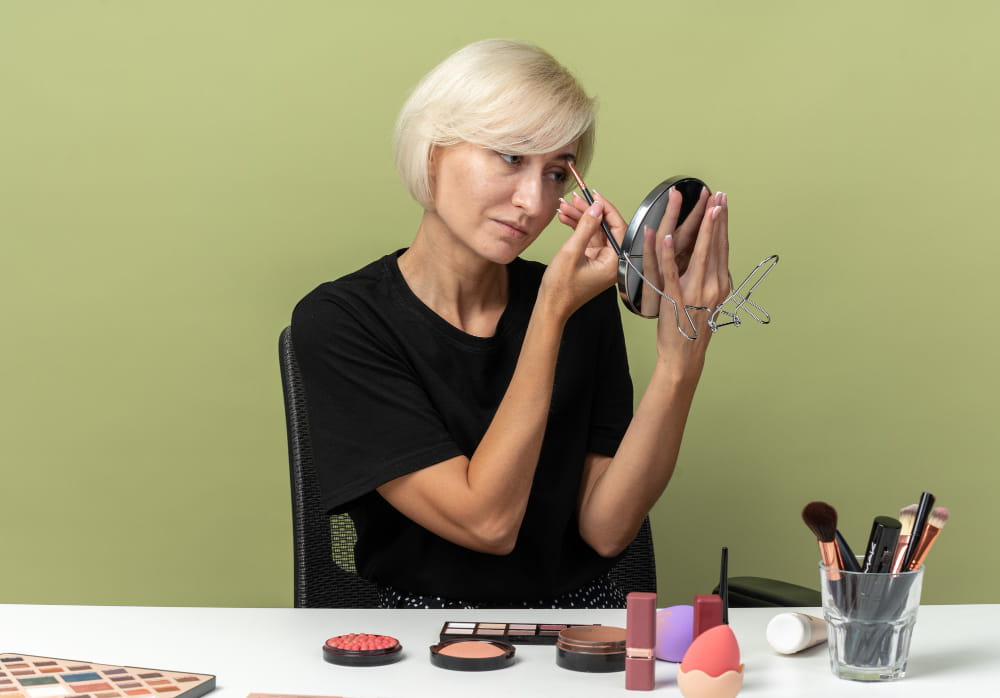
Brows are worth their own attention because they do more structural work on the face than most other makeup steps. Defined brows frame the eyes, lift the middle of the face visually, and do a remarkable amount of heavy lifting in terms of overall impression. As brows thin — which happens for most people at some point — a hair-stroke pencil (thin, precise, and available now from many brands) is more natural-looking than a heavy pomade or wax. The goal isn’t to draw brows back to where they were, but to fill in what’s there more densely. Feathery, realistic strokes. Not a single solid stroke. If brows are very sparse, tinting the remaining hair first and then penciling is worth the thirty minutes at a salon — it makes the pencil work significantly easier.
Cheeks and the Logic of Color
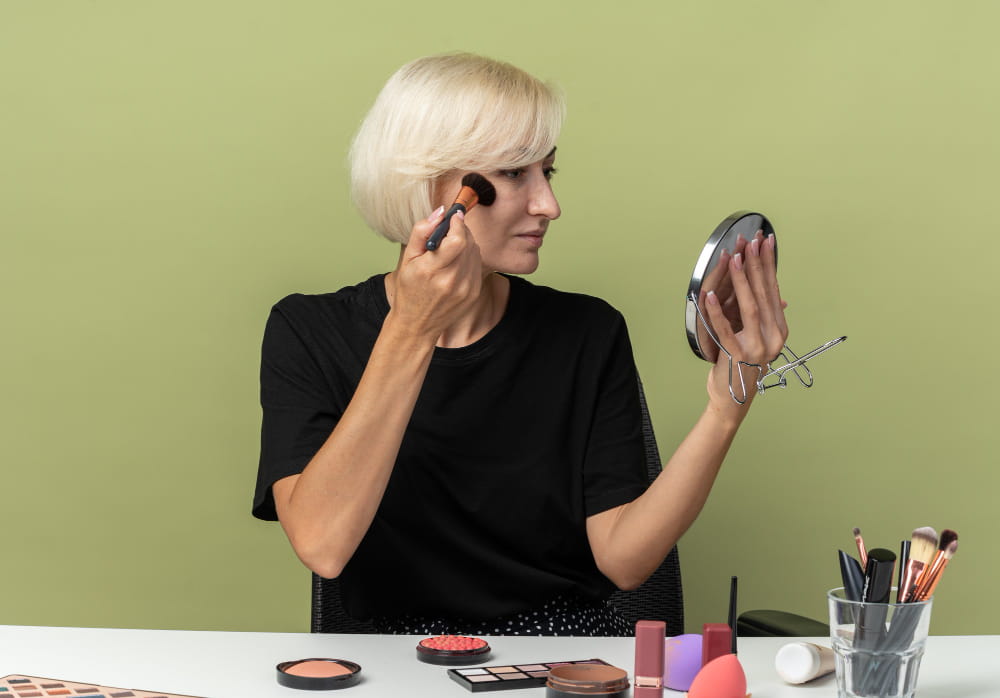
Cream blush is worth switching to if you haven’t. The reason isn’t aesthetic preference — it’s physical. Cream products move with the skin rather than sitting on top of it. On drier, more textured skin, powder blush can look patchy and can settle into texture in a way that cream doesn’t. Cream applied with fingers or a sponge warms and melts into the skin. The finish looks like color from within rather than color applied on top.
Placement shifts with face shape changes. Blush high on the cheekbones — closer to the temple, sweeping slightly upward — lifts. Blush placed low on the apple of the cheek (the childhood-portrait method) can pull the face downward, emphasizing the shift in volume that’s already happened. This isn’t a rule, it’s geometry.
The colors that work best tend to be the ones that echo your natural flush rather than contrast with it dramatically. As skin tone changes, the bright coral that looked summery at 35 might read orange now. It might not — skin tone varies enormously. But if a color you’ve worn for years suddenly looks off, the color hasn’t changed, but the undertone relationship between it and your skin may have.
Bronzer and highlight both require a lighter hand than they used to, and the reason is again physics. Skin with less underlying fat reflects and absorbs light differently. Heavy shimmer — chunky glitter highlight, dense bronze — catches in texture and can look glittery rather than glowing. The distinction between glow and shimmer matters here: glow is what happens when the skin itself looks light-reflective. Shimmer is what happens when you’ve applied a product with visible particles. On a face with texture and movement, the former reads as beautiful and the latter reads as sparkly. Creamy, finely milled highlighter applied lightly to the top of the cheekbones and occasionally the brow bone is usually more than enough.
Lips: Definition Without Drama
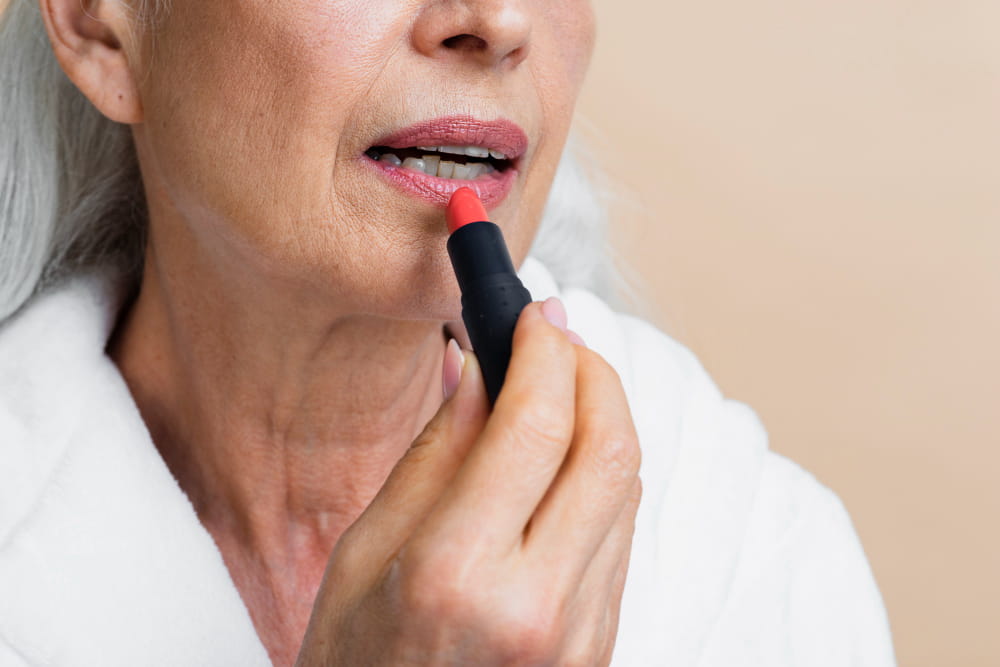
Lip liner has gotten a reputation as an aging signifier, which is ironic given that it’s genuinely more useful now than at any earlier point. As lips thin slightly and the skin around them loses some firmness, the lipstick-stays-in-the-lips problem becomes more real. Product feathers into the fine lines around the mouth. Lip liner solves this — but only when applied correctly, which means tracing just inside or exactly on the natural lip line, not outside it. Drawing outside the natural line doesn’t plump lips; it just looks drawn-on.
Lining before lipstick and then filling in the entire lip with liner extends the wear of the lipstick and gives it a defined edge to stay within. This is the technique, and it’s unglamorous and practical and works.
Lip-plumping glosses: some people love them, some find the tingly sensation uncomfortable. Be honest with yourself about which you are. They work by mildly irritating the lip tissue to produce temporary swelling — the effect is real but subtle and short-lived. If you like the feel, they’re worth using. If the sensation bothers you, no amount of promised plumping is worth applying them.
Lip color tends to shift as lip tone changes. The deep reds and bright pinks that worked at 30 may feel stark against a paler lip. They may also still work completely — this is not a rule. What’s worth checking is whether your longtime favorite colors still feel like yours, or whether you’re wearing them because you’ve always worn them.
Where to Spend and Where to Save
Foundation and skincare prep are worth investing in. The formula genuinely matters in ways that it doesn’t for most color products. A good serum foundation or tinted moisturizer performs differently from a drugstore option — the finish, the skincare ingredients, the way it wears — and this is one of the few beauty categories where the price difference reflects something real.
Color products — blush, eyeshadow, bronzer — are largely interchangeable above a certain baseline of quality. A well-reviewed drugstore cream blush performs comparably to a luxury one. The exception is anything with a finish that matters: very finely milled powder highlighters do sometimes have a different texture than cheaper versions. But as a general rule, buy your base and your skincare. Be casual about everything else.
The One Thing That Actually Matters
After all of that — technique and formula and placement — the thing that makes makeup look genuinely good on any face, at any age, is whether it looks chosen. Not maintained. Not habitual. Chosen.
The makeup that looks best on women over 50 is almost always the makeup that’s been updated to reflect who they are now rather than preserved from two decades ago. This isn’t about trends. It’s not about looking younger. It’s about the specific shades, finishes, and application methods that suit the current face — its current skin, its current bone structure, its current coloring. The foundation formula you’ve used since your 30s might be wrong for your skin now. The brow technique might need to shift. The blush placement might be off by an inch.
None of that is loss. It’s just calibration. And women who wear makeup that’s been calibrated to who they actually are — rather than who they were — look significantly more like themselves than women who’ve kept the same look out of loyalty or inertia.
That’s what these tips are actually for.
The information in this post is based on personal research and experience and is intended for educational purposes only. It is not a substitute for professional medical or dermatological advice, diagnosis, or treatment. Always consult a qualified healthcare provider before making changes to your skincare routine or health practices, especially if you have a medical condition or sensitivity.
