
This post contains affiliate links. If you click a link and make a purchase, I may earn a small commission at no extra cost to you. I only recommend products I genuinely believe in. Thank you for supporting Amoria Style!
Most people treat their body skin as a simplified version of their face — the same principles, just less attention. Moisturise when dry. Exfoliate occasionally. Use SPF if going outside. The products are cheaper, the routine is shorter, and the expectation is that everything works roughly the same way, just with less effort.
This assumption explains why body skin so often stays stubbornly rough, dry, or uneven despite regular moisturising — and why the products that transformed your face routine often do nothing on your body. Body skin and facial skin are not the same tissue. They have different structures, different densities, different barrier properties, and different responses to ingredients. Understanding those differences changes what you reach for and why.
The Structural Difference That Changes Everything
The outermost layer of skin — the stratum corneum — functions as the primary barrier between the body and the environment. It regulates water loss, blocks external irritants, and determines how well topical ingredients penetrate.
On the face, the stratum corneum is relatively thin — typically 10 to 15 cell layers deep. On the body, it is significantly thicker, particularly on areas like the shins, elbows, knees, and heels, where it can be 20 to 30 cell layers deep or more. This thickness is protective — the body is exposed to more friction, pressure, and environmental stress than the face — but it also means that topical ingredients have a harder time penetrating to where they need to be.
This is the core reason why a hyaluronic acid serum that visibly plumps your face does almost nothing on your legs. The molecule is simply not getting through a barrier built to withstand considerably more than it encounters on facial skin. The same logic applies to vitamin C serums, niacinamide, and most active ingredients formulated for facial use — the penetration depth required to be effective on body skin is rarely achieved by facial-formula concentrations.
What this means practically: body skin generally requires either higher concentrations of active ingredients, occlusive application methods that force deeper penetration, or ingredients specifically chosen for their ability to work at or near the surface of a thicker barrier.
Sebaceous Glands — Where They Are and Where They Are Not
The face is one of the most sebaceous-gland-dense areas of the body. Sebaceous glands produce sebum — the skin’s natural oil — which contributes to the skin barrier, provides natural antimicrobial protection, and prevents transepidermal water loss.
Large areas of the body have significantly fewer sebaceous glands. The lower legs, shins, and forearms are among the least sebaceous areas of the body. This is why these areas dry out faster, lose moisture more readily, and require more consistent external moisturisation than facial skin, which has a more self-sufficient natural oil production system.
The practical implication: what feels like an adequate moisturiser on your face may be genuinely insufficient for your legs — not because the product is bad, but because body skin in low-sebaceous areas has far less natural moisture retention working alongside it. A moisturiser that works well on the face by supporting existing sebum may provide little benefit on the shins where there is minimal sebum to support.
For body skin in low-sebaceous areas, the moisturiser needs to do significantly more of the work itself — which tends to mean preferring occlusives (ingredients that physically seal moisture in, like petrolatum, shea butter, and dimethicone) over humectants (ingredients that draw moisture from the environment, like hyaluronic acid and glycerin), which work better in environments with available moisture and in conjunction with natural oils that help retain what is drawn in.

Transepidermal Water Loss — Why Body Skin Dries Out Differently
Transepidermal water loss (TEWL) is the rate at which water evaporates through the skin’s surface. It is the primary mechanism of skin dryness — not a lack of water in the environment, but water leaving the skin faster than it is retained.
TEWL rates vary significantly across the body. The face, despite having a thinner stratum corneum, has lower TEWL rates than many body areas because sebum and facial moisturisers are applied consistently and the barrier is maintained more carefully. The lower legs have among the highest TEWL rates of any body area — they lose moisture quickly, have limited natural oil production to slow that loss, and are frequently exposed to barrier-disrupting factors like hot showers, friction from clothing, and shaving.
Hot showers are worth addressing specifically because they are one of the most significant and most overlooked contributors to body skin dryness. Water temperature above roughly 40°C begins to strip the lipids that hold the skin barrier together. A long hot shower removes the skin’s natural oils more effectively than almost any other daily activity — and the dryness that follows is not simply dehydration but actual barrier disruption that takes hours to fully restore. Applying body moisturiser immediately after a shower (within two to three minutes, on still-damp skin) is specifically effective because it traps the surface moisture before TEWL accelerates as the skin dries. Waiting until the skin is fully dry before moisturising means applying into an already-compromised state.
Keratosis Pilaris — What It Actually Is and Why Standard Moisturisers Do Not Fix It
Keratosis pilaris — the rough, bumpy texture most commonly appearing on the upper arms, thighs, and sometimes cheeks — affects a significant proportion of the population and is one of the most frequently misunderstood body skin conditions in terms of treatment approach.
Keratosis pilaris is caused by the overproduction of keratin, the structural protein that makes up the outer layer of skin. In keratosis pilaris, keratin accumulates in hair follicles faster than it is shed, forming plugs that create the characteristic rough, raised bumps. The skin around the plugs is often dry and can appear red or brown depending on skin tone.
Standard moisturisers do not address keratosis pilaris because they work at the surface of the skin and do not affect the keratin accumulation occurring inside the follicle. What does address it are chemical exfoliants with keratolytic properties — ingredients that dissolve the bonds holding dead keratin cells together, allowing them to shed rather than accumulate.
The most effective keratolytic ingredients for keratosis pilaris are:
Urea — at concentrations of 10% and above, urea is both a humectant (drawing moisture into the skin) and a keratolytic (breaking down excess keratin). It is one of the most evidence-supported ingredients for both dry body skin and keratosis pilaris and is significantly underused in standard skincare routines because it is less marketed than newer actives. At 20-40% concentration, urea becomes a more aggressive keratolytic used for extremely rough areas like heels.
Lactic acid — an alpha hydroxy acid (AHA) that exfoliates at the surface and has some keratolytic effect. At 5-12% concentration in a leave-on lotion format, it helps with both the texture and the dryness component of keratosis pilaris. It is gentler than glycolic acid and better tolerated on body skin.
Salicylic acid — a beta hydroxy acid (BHA) that is oil-soluble, allowing it to penetrate into the hair follicle rather than working purely at the surface. This follicle-penetrating property makes it specifically useful for keratosis pilaris because the keratin plug is inside the follicle. Leave-on body lotions with 1-2% salicylic acid are more effective for this condition than surface-level exfoliation.
Physical exfoliation — scrubs, dry brushing, loofahs — provides temporary smoothing by removing surface dead skin cells but does not address the keratin plug inside the follicle. Results feel immediate but do not last, and aggressive physical exfoliation can irritate and inflame the surrounding skin, worsening the redness component.
Why Body Skin Ages Differently — And What That Means
The face receives the most attention in anti-ageing skincare, but body skin ages through a somewhat different mechanism and shows different signs.
Facial ageing is driven primarily by UV damage (photoageing), muscle movement (expression lines), and volume loss in the underlying fat and bone structure. Body skin — particularly on areas that are usually covered — ages more slowly in terms of UV-driven photoageing, but it loses elasticity and collagen through the same intrinsic ageing processes and shows this loss differently: as crepey texture, loss of firmness on the inner arms and thighs, and increased roughness on the shins and elbows.
Retinoids — the most evidence-supported anti-ageing ingredient in facial skincare — work on body skin but require adjustment in approach. Body skin tolerates retinoids better than facial skin because the thicker stratum corneum buffers the initial irritation that makes retinoid introduction on the face require careful titration. However, because body skin has lower sebaceous activity, the dryness that retinoids can cause (by increasing cell turnover and temporarily disrupting the barrier) is more pronounced and requires pairing with a richer moisturiser than is typically used on the face.
Applying a facial retinol product to the body is generally ineffective because the concentration is formulated for the thinner facial barrier. Body-specific retinol products at higher concentrations, or prescription retinoids (tretinoin) applied to specific areas of concern, are more likely to produce visible results.
The Ingredient Hierarchy for Body Skin
Given the structural differences above, here is how to think about ingredient selection for body skin specifically:
Occlusives first for dry skin: Shea butter, petrolatum, dimethicone, and squalane create a physical barrier that prevents TEWL. These are the highest-priority ingredients for body skin dryness because they address the mechanism (water leaving the skin) rather than just adding water temporarily.
Humectants need pairing: Glycerin and hyaluronic acid draw moisture to the skin but require an occlusive layer to retain it, and they work best in environments with adequate ambient humidity. Applied alone on dry body skin in low-humidity conditions, humectants can pull moisture from deeper skin layers to the surface, where it then evaporates — temporarily worsening dryness.
Urea is underrated: A 10-20% urea body lotion addresses both dryness and rough texture simultaneously and is the single most effective ingredient change most people can make to their body skincare routine. It is available at low cost in pharmacy own-brand formulations and outperforms most premium body moisturisers that are primarily humectant-based.
Chemical exfoliants over physical: For texture concerns, rough patches, and keratosis pilaris, leave-on chemical exfoliants (lactic acid lotion, salicylic acid body wash left on briefly before rinsing, urea cream) produce more consistent and lasting results than scrubs, which address only the surface.
SPF on exposed areas, consistently: The hands, forearms, décolletage, and neck age faster than covered body areas purely because of cumulative UV exposure. SPF application to these areas is as important as facial SPF for long-term skin quality and is the most underutilised body care step in most people’s routines.
The Routine That Actually Works for Body Skin
The most effective body care routine is not more products — it is the right products applied at the right time in the right way.
In the shower: Lukewarm water rather than hot (or as cool as is tolerable). Gentle, fragrance-free body wash on areas that need cleansing; plain water on others. If using a salicylic acid body wash for keratosis pilaris or body acne, leave it on for 60-90 seconds before rinsing rather than washing off immediately.
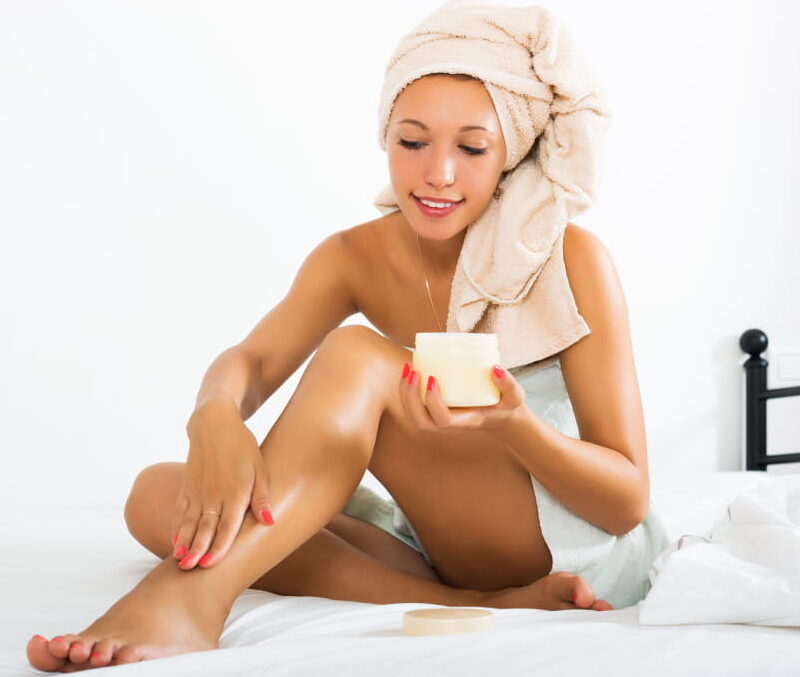
Immediately after showering: Apply body moisturiser within two to three minutes, on damp skin. This is the highest-leverage timing change available — it consistently outperforms the same product applied after the skin has fully dried.
Targeted treatment areas: Urea 10-20% cream on shins, elbows, knees, and heels. Lactic acid or salicylic acid lotion on keratosis pilaris areas (upper arms, thighs). Allow these to absorb before dressing.
Morning, on exposed areas: SPF 30-50 on hands, forearms, décolletage, and neck — applied after any other products have absorbed, before going outside.
The key shift in thinking about body skincare is not adding more steps. It is understanding that body skin has different needs than facial skin, and that what works on the face — lightweight serums, humectant-heavy formulas, frequent actives — is often the wrong category of product for a thicker, lower-sebum barrier that needs sealing and keratolytic support far more than it needs the latest facial active ingredient.
The information in this post is based on personal research and experience and is intended for educational purposes only. It is not a substitute for professional medical or dermatological advice, diagnosis, or treatment. Always consult a qualified healthcare provider before making changes to your skincare routine or health practices, especially if you have a medical condition or sensitivity.
