

This post contains affiliate links. If you click a link and make a purchase, I may earn a small commission at no extra cost to you. I only recommend products I genuinely believe in. Thank you for supporting Amoria Style!
The hardest dressing problem isn’t winter or summer — it’s the weeks in between, when mornings are cold enough to warrant a coat but afternoons are warm enough to regret it, when a single outfit needs to function across a 12-degree temperature range without looking like a compromise. Most advice for this problem is either obvious (“layer!”) or impractical (“carry everything with you!”). Neither helps much when you’re standing in front of a wardrobe trying to make a decision in under ten minutes.
Here’s a more specific framework — one that’s about construction rather than just volume of clothing.
Why "Just Layer" Fails as Advice
Layering is correct as a principle but unhelpful as instruction because it doesn’t tell you which layers, in what order, in what proportions. Random layering — adding pieces on top of each other without considering how they interact visually and practically — produces the “I couldn’t decide what to wear” look rather than the “I dressed intentionally for this weather” look. The difference between the two is almost entirely about proportion and layer compatibility.
Proportion means each layer needs to relate correctly to the ones around it — a bulky knit under a fitted coat creates visual tension and physical restriction; the same knit under an oversized coat works. A light shirt under a fitted blazer works; a chunky turtleneck under the same blazer doesn’t close properly and looks like an accident.
Layer compatibility means the pieces work as a system — they can be removed and added without the outfit falling apart at either temperature extreme. An outfit that only looks good with all layers on isn’t a transitional outfit, it’s a cold-weather outfit you’re hoping doesn’t get warm.
The Base Layer — Where Most People Go Wrong
The instinct in transitional weather is to start with a heavy base layer “just in case.” This is almost always a mistake because a heavy base layer limits what goes on top of it — it creates bulk that pushes outer layers away from the body, disrupts the visual line of the outfit, and often makes the whole thing too warm by midday.
A lighter base layer gives you more flexibility in both directions. A fitted long-sleeve in a lightweight fabric — merino, modal, or fine cotton — works under a blazer without creating bulk, works alone if the afternoon gets warm enough, and keeps you warmer than a heavier base layer actually would because it traps heat more efficiently against the skin rather than creating dead air space. [(The physics of insulation: thinner, closer-fitting layers trap warmth more efficiently than single thick layers when next to the body.)]
The base layer should also be a color that works independently — not just as a hidden underlayer. If the coat comes off, you should be wearing something that looks intentional, not something that only exists to be hidden.
The Middle Layer — The Most Useful and Most Neglected
Most transitional dressing advice goes directly from base layer to outerwear, skipping the middle layer entirely. This is where most of the dressing-for-temperature problem actually gets solved.
A middle layer — an open blazer, a light knit cardigan, an overshirt, an unstructured jacket — provides warmth that’s removable without removing outerwear, and warmth that doesn’t require outerwear at all once you’re inside. It’s the layer that makes an outfit work at 9am, at noon, and at 6pm without requiring a complete rethink.
The middle layer works best when it’s open-front or easily removed — closed knitwear that goes over the head is harder to add and remove throughout the day without disrupting hair and the base layer underneath. An open blazer, a zip cardigan, or a button-front overshirt solves this practically in a way a pullover knit doesn’t.
The Outer Layer — Choosing for Range, Not Just Cold
Outerwear for transitional weather needs to work across a wider temperature range than winter outerwear, which means it should be lighter, more packable, and ideally something that functions as a middle layer if the day gets warm enough to drop the outer layer entirely.
A trench coat is the classic answer here and earns its reputation — it’s genuinely more versatile across temperature ranges than almost any other outerwear option. Light enough to wear in mild weather, substantial enough to block wind and light rain, and structured enough to look intentional as either outerwear or as a middle-layer piece if left unbuttoned over something else.
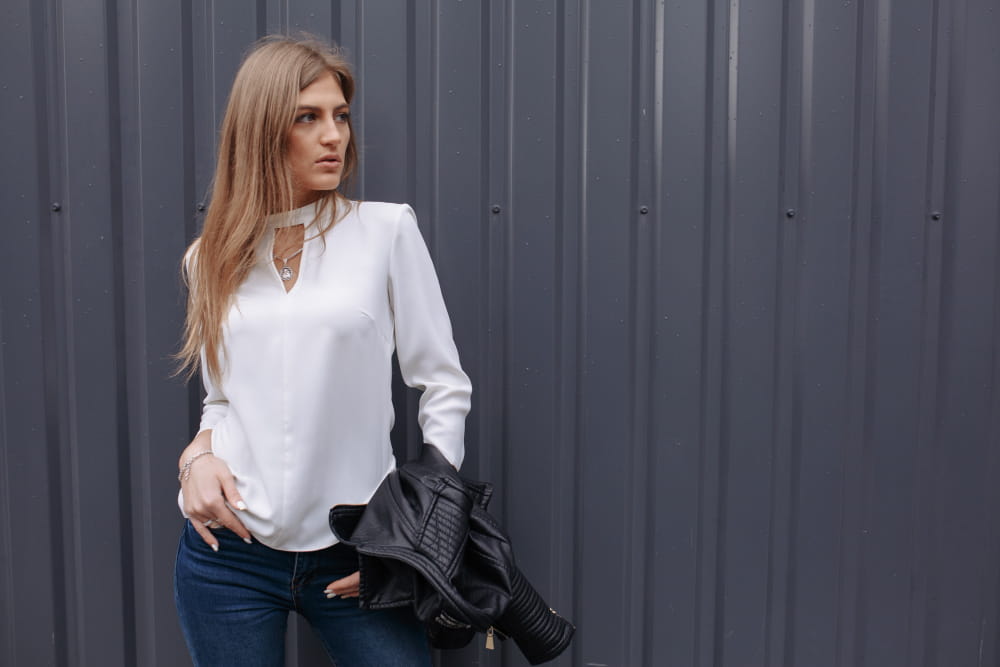
A leather or leather-look jacket serves a similar function for a more casual register — lightweight but wind-blocking, removable easily, and readable as intentional at most temperatures.
What doesn’t work well for transitional weather: heavy wool coats (too warm for the mild days, create too much bulk to carry), puffer jackets (either too warm or too casual for the contexts where transitional weather typically creates the most dressing problems), and waterproof technical shells (functional but rarely the visual register most people are aiming for day-to-day).
Fabric Choices That Actually Regulate Temperature
Beyond layering structure, fabric choice at each layer makes a significant difference to how well an outfit actually regulates temperature throughout the day.
Merino wool is the most functional fabric for transitional weather because it genuinely regulates temperature in both directions — it insulates when cold and doesn’t overheat when warm, due to its natural moisture-wicking and breathability properties. A merino base or middle layer genuinely performs differently from cotton or synthetic equivalents in changing temperatures, not just as a marketing claim.
Linen and linen blends for base layers in warmer transitional weather — they breathe better than cotton when temperatures swing upward, which means they remain comfortable at the warm end of a variable day in a way cotton doesn’t.
Avoid synthetic fleece as a transitional middle layer — it insulates well in one direction but traps heat and moisture when temperatures rise, which makes the too-warm problem significantly worse during the afternoon part of a variable day.

The Practical Test Before Leaving the House
One genuinely useful habit for transitional dressing: before finalizing the outfit, mentally run through both temperature extremes of the day ahead. At the cold end — is there enough warmth without the outer layer being uncomfortable? At the warm end — with the outer layer off, does the remaining outfit look complete and intentional, or does it look like half an outfit?
If both answers are yes, the outfit works for variable weather. If either answer is no, something needs adjusting — usually either the base layer (too heavy, limiting the warm end) or the middle layer (absent or too light, leaving the cold end uncovered).
Two questions, thirty seconds, before you walk out the door. More useful than any amount of general layering advice.
The transitional seasons are worth dressing well for rather than enduring in whatever combination of things seemed warm enough at 7am. The specific framework above — light base, open-front middle, packable outer, temperature-appropriate fabrics — is what makes that achievable rather than a daily guessing game.
