
This post contains affiliate links. If you click a link and make a purchase, I may earn a small commission at no extra cost to you. I only recommend products I genuinely believe in. Thank you for supporting Amoria Style!
Before we get into recipes, I want to establish something that most hair growth content refuses to say plainly: there are two completely different things happening when an oil “helps hair grow,” and mixing them up is why people feel disappointed after three months of diligent oiling.
The first mechanism is scalp health — creating an environment where follicles aren’t inflamed, aren’t blocked by DHT, and have decent circulation. Healthy follicles grow hair more consistently and shed less prematurely. The second mechanism is breakage reduction — protecting the hair shaft so that the centimeter of growth your follicles are already producing each month doesn’t snap off before it becomes length you can see.
These are not the same thing. An oil that reduces mechanical damage is not stimulating your follicles. A scalp treatment that improves circulation is not sealing your ends. Both are legitimate and worth doing — but they require different oils, different application zones, and produce different outcomes on different timelines.
Throughout this guide, I’ll tag each recipe with what it’s actually doing — [Scalp health], [Breakage reduction], or [Both] — and what level of evidence supports the claim: Strong evidence, Moderate evidence, or Traditional/anecdotal. This isn’t me hedging. It’s me respecting your time.
The Thing That Actually Has the Strongest Evidence: Scalp Massage
I’m putting this before the recipes because it’s the single most evidence-backed intervention in this entire guide — and it costs nothing.
A 2016 study by Koyama et al. had participants perform standardized scalp massage for four minutes daily. After 24 weeks, hair thickness had measurably increased. The mechanism isn’t mysterious: mechanical stimulation of dermal papilla cells (the structures at the base of each follicle that control hair growth), improved blood flow delivering oxygen and nutrients to follicles, and likely a reduction in stress hormones that are known to disrupt the hair cycle.
What this means practically: every oil recipe below should be applied with a real massage. Not a passive scalp rub while you think about something else — an actual systematic technique. I’ll cover the specifics in the application section, but the minimum effective dose from the research is four minutes. The oil is the vehicle. The massage is the intervention.
The 7 Recipes
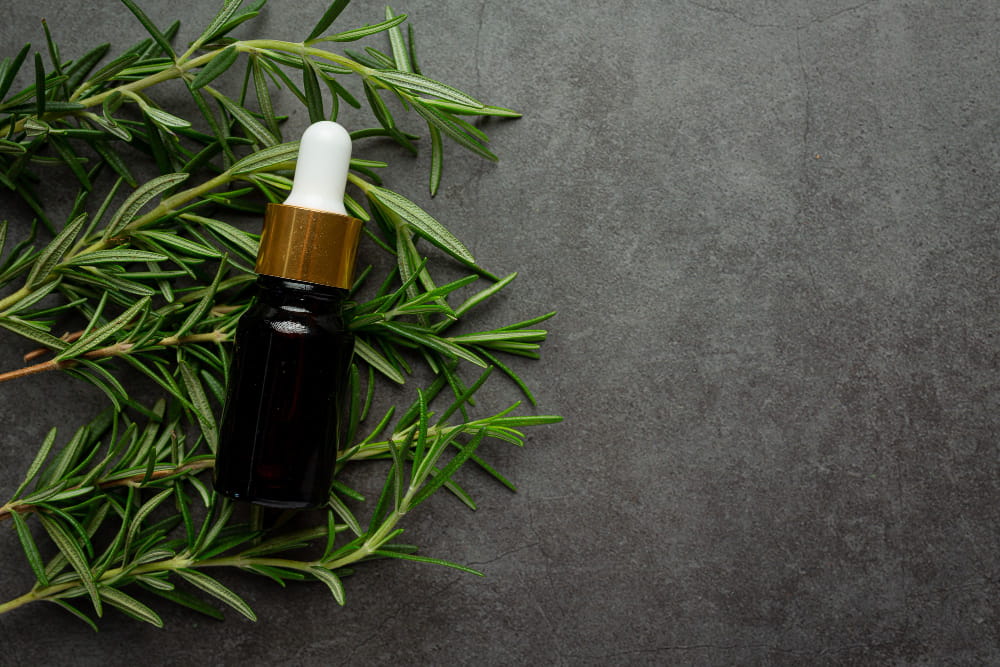
1. Rosemary and Jojoba Scalp Oil — [Both] — Moderate to Strong Evidence
The 2015 Panahi study compared rosemary leaf extract to 2% minoxidil over six months and found comparable hair regrowth — with less scalp itching in the rosemary group. I want to be honest about what that study was and wasn’t: it used a standardized extract at a specific concentration, the sample size was modest (100 participants), and it targeted androgenetic alopecia specifically. It’s genuinely encouraging, but it’s not a definitive clinical trial. Still, of the plant-based options available, rosemary has the strongest human research.
Jojoba is the right carrier here for a specific reason: chemically, it’s not a true oil but a liquid wax, and its structure closely resembles human sebum. This means it sits on the scalp without feeling greasy, absorbs reasonably well, and critically — it doesn’t clog follicles the way heavier oils can. For a scalp treatment, this matters a lot.
Recipe for a 30ml roller bottle:
- 30ml jojoba oil (fills the bottle)
- 12 drops rosemary essential oil (Rosmarinus officinalis)
- 5 drops lavender essential oil (anti-inflammatory, and it makes the scent bearable)
A roller bottle is the right format for scalp application — it deposits oil directly at the root without saturating your lengths, and the rolling ball provides mild mechanical stimulation as you apply. Fill the jojoba first, add the drops, cap and roll to combine. Apply along partings, then massage.
2. Peppermint and Castor Oil Blend — [Both] — Moderate Evidence
A 2014 study by Kim et al. found that peppermint oil, applied topically, promoted hair growth in mice comparable to minoxidil 3%. I’m flagging this is animal research — mouse follicle biology is not identical to human follicle biology, and translating these findings requires caution. But the proposed mechanism makes physiological sense: peppermint’s primary active compound, menthol, is a vasodilator. It increases local blood flow, which is the same basic mechanism behind minoxidil. The human-applicable signal is plausible enough to be worth including.
The more important thing to get right here is the dilution. Peppermint is one of the most irritating essential oils if used incorrectly, and “more peppermint = more tingly = more effective” is not how this works. Higher concentrations cause dermatitis and can make scalp conditions worse. The correct dilution for scalp use is 2–3%, full stop.
Castor oil earns its place through ricinoleic acid, a fatty acid with documented anti-inflammatory properties. Scalp inflammation — from seborrheic dermatitis, product buildup, or general irritation — disrupts the hair growth cycle. Castor oil doesn’t directly stimulate follicles, but reducing inflammatory conditions around them is legitimate support.
Recipe for 30ml:
- 25ml castor oil
- 5ml fractionated coconut oil (castor is very thick; this makes it workable)
- 9 drops peppermint essential oil (that’s your 2–3%)
Note that castor oil is sticky and heavier — this one benefits most from a pre-shampoo application rather than an overnight treatment.
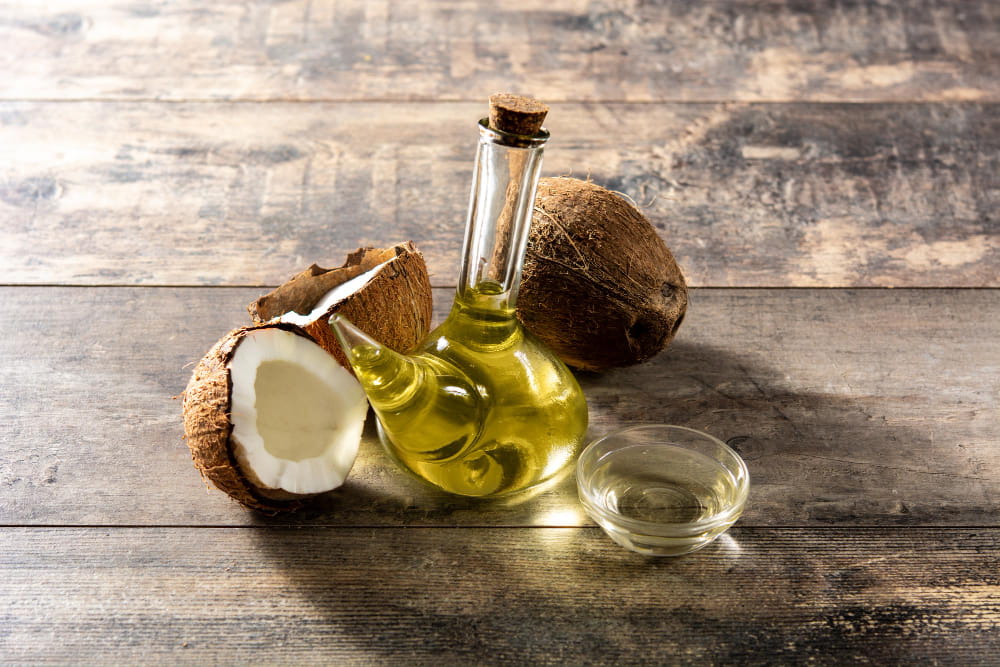
3. Bhringraj and Coconut Oil — [Scalp health] — Traditional/Anecdotal with Emerging Research
Bhringraj (Eclipta prostrata) has been central to Ayurvedic hair care for centuries. There are preliminary studies showing it may support follicle proliferation — one study on mice showed it outperformed minoxidil in promoting anagen (growth phase) follicles — but human clinical trials are absent. I’m listing this as traditional/anecdotal with an honest note that the mechanism being studied is interesting enough that I wouldn’t dismiss it.
Sourcing: dried bhringraj herb is readily available from Indian grocery stores (look for the Ayurvedic or herb section) or online from reputable herbal suppliers. You want the dried herb, not a pre-made oil of uncertain quality or concentration.
Infusion method:
- Place 2 tablespoons of dried bhringraj in a small heatproof jar
- Cover completely with coconut oil (approximately 100ml)
- Set the jar in a pan of water and warm gently over low heat for 2–3 hours — you want the oil warm, not simmering. Keep the water level below the jar lid.
- Alternatively, seal the jar and leave it in a warm spot (a sunny windowsill works) for 2–4 weeks, shaking daily
- Strain through cheesecloth, pressing the herb to extract the infused oil
- The finished oil keeps for 2–3 months in a cool, dark location
Apply warm to the scalp, massage thoroughly, leave for at least 30 minutes before washing. Coconut oil is one of the few oils proven to penetrate the hair shaft, so this blend pulls double duty — scalp treatment and some shaft conditioning.
4. Saw Palmetto and Argan Blend — [Scalp health] — Moderate Evidence (for hormonal hair loss specifically)
This one has a very specific use case, and I want to be clear about it: saw palmetto is most relevant for androgenetic alopecia — the hormonally-driven pattern hair loss that presents as a receding hairline in men or diffuse thinning at the crown in women. If your hair loss has other causes — nutritional deficiency, postpartum shedding, stress-related telogen effluvium, or scalp conditions — this recipe isn’t targeting your problem.
The mechanism: saw palmetto inhibits 5-alpha reductase, the enzyme responsible for converting testosterone to dihydrotestosterone (DHT). DHT is what miniaturizes hair follicles in people with androgenetic alopecia — it causes each growth cycle to produce a progressively thinner, shorter hair until the follicle eventually stops producing visible hair altogether. By partially blocking this conversion, saw palmetto intervenes at the hormonal level. Studies using oral saw palmetto have shown modest positive effects; topical application is less studied but mechanistically plausible.
Argan oil is the right carrier for the same reason rosemary needs jojoba — it’s lightweight, non-comedogenic, and its fatty acid profile (high in oleic and linoleic acids) supports scalp barrier function without heaviness.
Recipe for 30ml:
- 28ml argan oil
- 10 drops saw palmetto essential oil (or 1ml saw palmetto CO2 extract, which is more concentrated and better studied)
- 5 drops rosemary essential oil (complementary DHT-blocking evidence)
- 3 drops cedarwood essential oil
Apply to the scalp along the areas of concern, massage well, and ideally leave on for a few hours. Consistency over months is what the research points to — this isn’t a quick-result intervention.
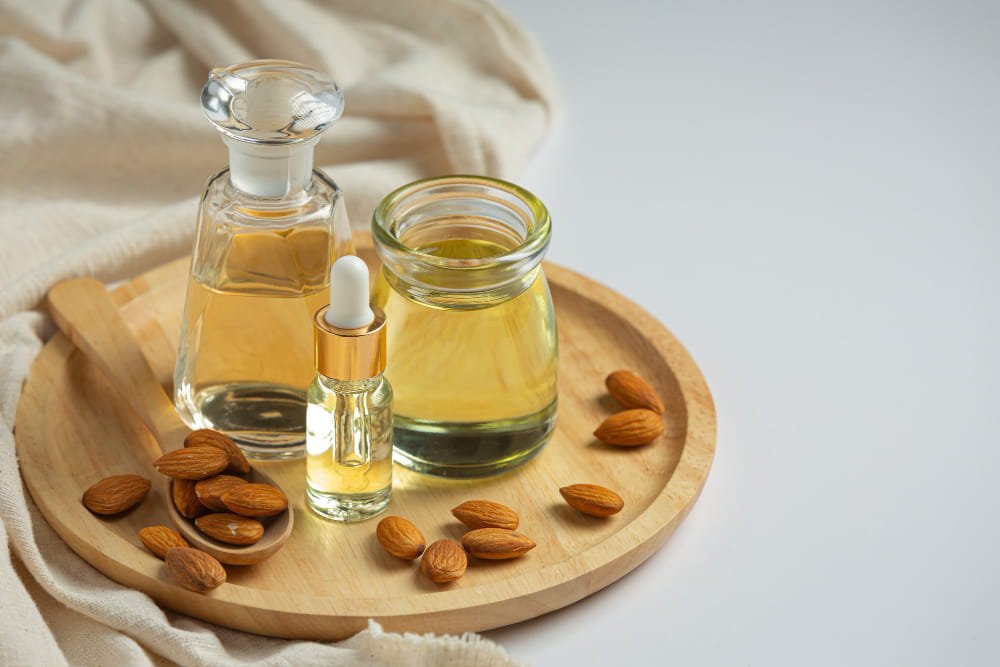
5. Amla and Sweet Almond Oil — [Both] — Traditional with Growing Research
Amla (Indian gooseberry, Phyllanthus emblica) is one of those traditional ingredients that’s starting to look more interesting as it gets properly studied. It’s extraordinarily high in vitamin C and tannins, and recent research has found that it inhibits 5-alpha reductase — the same enzyme saw palmetto targets. There are also studies suggesting it extends the anagen (growth) phase of the hair cycle, though this is preliminary.
What I appreciate about amla is that its traditional use is centuries deep and spans multiple cultures, which doesn’t prove efficacy but does suggest it doesn’t cause harm and may produce observable results. The vitamin C content is relevant for collagen synthesis in the scalp, and the tannins have astringent and antimicrobial properties useful for oily or dandruff-prone scalps.
Sweet almond oil is a classic, gentle carrier — good slip, moderate weight, suitable for both scalp and lengths.
Infusion method:
- Mix 2 tablespoons amla powder with 100ml sweet almond oil in a small saucepan
- Warm over very low heat for 15–20 minutes, stirring occasionally. Don’t let it boil.
- Strain through a fine mesh or cheesecloth
- The powder will settle; pour off the clear oil and discard the sediment
- Store in a dark bottle — vitamin C degrades in light
The color will be greenish-yellow to golden depending on the amla source. Apply to scalp, massage in, and this one works well as an overnight treatment if you use a shower cap.
6. Cedarwood Blend — [Scalp health] — Moderate Evidence (specific to alopecia areata)
This recipe is directly modeled on the Hay et al. 1998 study, which tested aromatherapy massage in patients with alopecia areata (an autoimmune condition causing patchy hair loss). The treatment group used a blend of cedarwood, lavender, thyme, and rosemary in jojoba and grapeseed carrier oils, massaged daily. After seven months, 44% of the treatment group showed improvement versus 15% in the control group.
The caveats: this was a small study (86 participants), the study design had limitations, and alopecia areata is an autoimmune condition that behaves differently from other hair loss types. This blend isn’t proven for general hair thinning. But it is the most direct clinical reference for a topical aromatherapy blend, and the oils involved are reasonable to use regardless.
Recipe replicating the study blend for 30ml:
- 22ml jojoba oil
- 8ml grapeseed oil
- 6 drops Virginia cedarwood essential oil
- 4 drops lavender essential oil
- 3 drops thyme essential oil (use Thymus vulgaris linalool chemotype — it’s gentler than standard thyme)
- 4 drops rosemary essential oil
This is the closest formulation to what was used in the research. Daily scalp massage for the full massage duration.
7. Nourishing Length-Retention Oil — [Breakage reduction] — Strong Evidence
I want to be completely direct: this oil does not stimulate your follicles. It will not make your hair grow faster in the biological sense. What it does is protect hair that is already growing from the mechanical damage — friction, heat, elasticity stress, manipulation — that causes it to break before you ever see it as length.
This distinction matters because most people lose significant length to breakage rather than to slow follicle activity. The average scalp grows 1–1.5cm per month. If your hair doesn’t seem to be getting longer, the question to ask is not “how do I make it grow faster?” but “where is the length I’ve already grown going?” This oil answers the second question.
Argan oil’s oleic acid penetrates the cortex and reduces protein loss from heat and chemical exposure — this is well-documented. Vitamin E is both an antioxidant (protecting against oxidative damage) and a conditioning agent. I’ve deliberately excluded silicones here despite their effectiveness, because many people prefer to avoid them; if you want to add slip for detangling, a few drops of cyclomethicone-free, dimethicone-free amino-silicone is effective but entirely optional.
Recipe for 50ml:
- 35ml argan oil
- 10ml sweet almond oil
- 5ml rosehip seed oil (linoleic acid, helps with porosity)
- 10 drops vitamin E oil (tocopherol, not tocopheryl acetate)
- 5 drops ylang ylang essential oil (optional, shown to have some follicle stimulation properties, mostly here for scent)
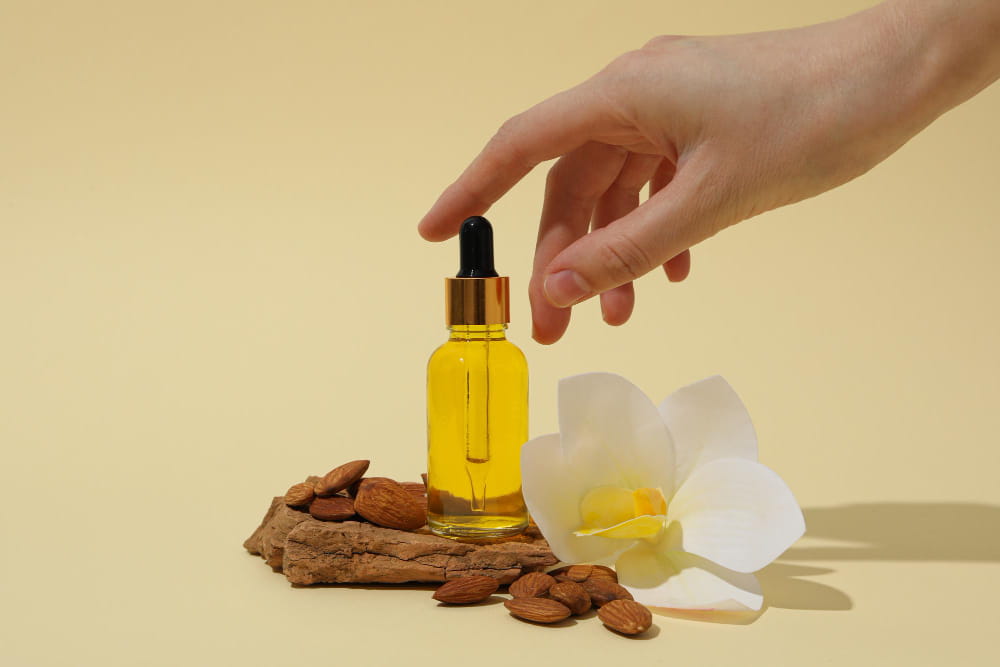
This goes on lengths and ends, not the scalp. Work it through damp hair after washing, concentrating on the last third of the hair. It can also be used as an overnight treatment on dry hair — seal ends, then sleep on a silk pillowcase. The evidence for reduced breakage with regular oil application is strong and consistent across multiple studies.
Application: How to Actually Use These
The most common reason scalp oils don’t produce results isn’t the formula — it’s inconsistent or incorrect application. Here’s what actually matters:
Sectioning. Part your hair into four quadrants — a horizontal part ear to ear across the crown, then a vertical part front to back. Work through each quadrant systematically rather than just pouring oil wherever. For the scalp oils (recipes 1–6), you want oil on the scalp, not floating on top of your hair.
Massage technique. Use the pads of your fingers, not your nails. Apply gentle but firm pressure in small circular motions. Move methodically across the scalp rather than staying in one spot. Four minutes minimum — set a timer the first few times until it feels natural. Some people prefer an “inversion” technique (hanging the head below the heart while massaging) for increased blood flow, though the evidence for inversion specifically is anecdotal.
Frequency. Two to three times per week is the evidence-aligned sweet spot. More than this causes buildup that can clog follicles and make washing more difficult, particularly with heavier oils like castor. Daily massage without oil is perfectly reasonable and arguably more important than the oil frequency.
Removal without stripping. Apply oil to the scalp before wetting your hair, then shampoo normally — the surfactants lift the oil effectively without needing double-shampooing. Alternatively: apply a small amount of dry shampoo to the scalp first (it absorbs excess oil), then wet and shampoo. This prevents the “oil slick” feeling that can result from shampooing over heavy oils.
What not to leave overnight. The length-retention oil (recipe 7) is fine overnight. The infused oils (bhringraj and amla) are fine overnight with a shower cap. The essential oil blends at the concentrations listed — recipes 1, 2, 4, and 6 — are formulated for shorter-contact application. At 2–3% dilution, they’re safe for several hours, but if you have any scalp sensitivity, rinse within two to four hours rather than sleeping in them.
Realistic Expectations and What to Measure
Your hair grows roughly 1 to 1.5 centimeters per month. No topical treatment is going to significantly accelerate the biological clock of the follicle. What scalp treatments do is optimize the conditions for that growth to happen consistently — fewer prematurely shed hairs, less inflammation, better follicle oxygenation.
What you’ll likely notice first (4–6 weeks): reduced shedding on your brush or in the shower drain. This is often the most immediate measurable sign that scalp conditions have improved. Second: improved scalp texture — less flaking, less irritation, reduced oiliness or dryness depending on what you started with. Third: improved hair texture from the carrier oils, which shows up relatively quickly.
What takes longer (3–6 months): actual retained length. This is the real outcome metric. Take a photo of your hair length at the start. Measure again at three months and six months. Length retention — hair that grew and didn’t break off — is what you’re trying to see.
What won’t happen: your hair won’t go from 5cm monthly growth to 10cm. The studies on even the most effective topical treatments show improvements in hair count and thickness, not dramatic acceleration of the growth rate itself. Managing expectations isn’t pessimism — it’s how you stay consistent long enough to actually see results.
Pick one or two recipes that match your hair loss type and situation. Use them consistently. Massage every time. Measure at six months.
The information in this post is based on personal research and experience and is intended for educational purposes only. It is not a substitute for professional medical or dermatological advice, diagnosis, or treatment. Always consult a qualified healthcare provider before making changes to your skincare routine or health practices, especially if you have a medical condition or sensitivity.
