
This post contains affiliate links. If you click a link and make a purchase, I may earn a small commission at no extra cost to you. I only recommend products I genuinely believe in. Thank you for supporting Amoria Style!
Something shifted with hair accessories, and I noticed it gradually — the way you notice a change in light before you realize the season has turned. It used to be that a clip was a solution to a problem: hair in your face, hair too hot, hair between washes and not presentable enough to leave down. You grabbed whatever was on the bathroom counter and got on with your day.
That’s not what’s happening anymore.
In 2026, the clip you choose communicates something before you’ve said a word. A gold claw clip twisted into a messy bun at the crown reads as intentional, put-together, someone who has their morning under control. A flower clip worn low at the side of a half-up says something softer, more romantic, more willing to be looked at. A pack of red snap clips scattered through the front of your hair signals a personality — playful, a little retro, not taking the day too seriously. Same hair, completely different message. The question stopped being “which clip holds my hair?” and became “what do I want my hair to say today?”
That reframe is what makes this particular moment in accessories interesting to me. I’ve spent a lot of time researching what actually works in women’s fashion and beauty — not what’s theoretically on trend, but what translates into real outfits on real people — and hair accessories are consistently underestimated as a styling tool. They’re small, they’re relatively inexpensive, and they’re completely reversible. But the right one can finish an outfit the way the right earring does: with intention.
Here are eleven clips I think are genuinely worth your attention right now.
The Polished Everyday Picks
Let’s start with the clips that do the heaviest lifting — the ones you reach for when you need to look like you made an effort without actually spending twenty minutes on your hair.
Gold is having a sustained moment in hair accessories, and the High Stakes Claw Clip in Gold illustrates exactly why. The finish does something fundamental to how a messy bun reads. In a black or plain tortoiseshell clip, a messy bun looks casual — which is fine, that’s often the point. But a gold claw clip at the crown of the head reframes the same style as deliberate. Suddenly the looseness looks like the French approach to undone hair rather than Wednesday morning in a rush. It’s the same physical hairstyle; the accessory is what changes the register.
In terms of what it actually holds: claw clips in this style work best for medium-to-thick hair with some length — roughly shoulder length and beyond. Fine hair can still make them work, but you’ll want to build a little volume at the base before clipping so the clip has something to grip. The gold tone reads particularly well against warm-toned hair (brunettes, blondes with golden or honey tones, reds), though it doesn’t clash with cool tones the way you might expect — gold in accessories has become neutral enough that most people can carry it.
👉 High Stakes Claw Clip in Gold


The Take It Off Hair Clip in Gold is a different tool entirely, even though it shares the same finish. Where the claw clip gathers and holds volume, this clip sits flatter against the hair — it’s the one you reach for when you want hair swept back or partially pulled away from the face without the fullness that a claw clip creates. Think: slick low half-up, twisted side pieces pinned back, the kind of styling that works with straighter or sleeker hair rather than a messy bun aesthetic. Against a tailored blazer or a silk shirt, this reads cleaner and more architectural. It’s a subtler choice, which means it tends to complement the outfit rather than draw attention to itself — and sometimes that’s exactly what you want.
👉 Take It Off Hair Clip in Gold

Tortoiseshell has been a consistent presence in hair accessories for going on three years now, and I keep waiting for it to tip over into overexposure the way trends usually do. It hasn’t. The reason, I think, is that tortoiseshell sits in the same category as navy or camel in clothing — it’s warm, it’s rich, it works against almost every hair color, and it doesn’t really age. The Glimmering Clip in Tort updates the classic finish with a slight shimmer — not rhinestone-level sparkle, just enough gloss to catch light differently than matte tort does. What that shimmer adds is lift: the clip reads more intentional, more finished. On dark hair, the amber tones in tortoiseshell create a complementary warmth that almost acts like a highlight. On blonde hair there’s a gorgeous tonal echo. On grey or silver hair, the contrast is striking in the best way. Tort works on almost everyone, and the glimmering version makes the classic feel current rather than inherited.
👉 Glimmering Clip in Tort

For anyone who leans cool-toned in their jewelry and accessories — the silver rings, the platinum watch, the icy-toned wardrobe — the Ellarah Hair Clip in Silver is the piece that makes everything feel coherent. There’s a styling principle I find genuinely useful: metal tones in accessories work best when they’re consistent within an outfit. Silver earrings and a gold hair clip can work, but they create a low-level visual tension that most people sense without being able to name. The Ellarah in silver resolves that tension if your jewelry leans cool. It’s also worth noting that silver reads particularly well against darker hair — the contrast is sharp and high-impact in a way that gold against dark hair sometimes isn’t. If your wardrobe is built around grey, white, black, and cool-toned blues, this is the clip that belongs in your rotation.
👉 Ellarah Hair Clip in Silver

The Statement and Floral Picks
I want to address flower hair accessories directly, because they’ve divided people in a way that other trends haven’t: some women have fully embraced them, and others remain convinced that flowers in hair will always read as a costume or a Pinterest wedding. I think the second camp is responding to bad execution rather than the idea itself.
What makes a flower clip work in 2026 is the same thing that makes any statement accessory work: scale, placement, and integration with the rest of the outfit. A flower clip that’s too small disappears and reads as an afterthought. One that’s too large dominates everything else. Worn at the front of the head in a half-up, it becomes the focal point of the look — the outfit should support it, which generally means keeping everything else quieter. Worn lower, tucked into a bun or twisted into a low ponytail, it reads as a finishing detail rather than a statement, which gives you more flexibility with what you’re wearing. The broader shift toward more expressive, feminine dressing has created the context for these to work — in a moment when maximalism has permission, a flower in the hair is just part of the vocabulary.
The Malissa Flower Hair Clip in Multi is the version for people who want the accessory to do a lot of work — the multi-color combination means it picks up tones from almost any outfit without being specifically matched to one. This works particularly well on a half-up style where the clip sits mid-head with hair flowing behind it, or tucked into a low bun as a deliberate burst of color against a neutral outfit. Pairing-wise: white or cream pieces, natural linens, anything where you want one element that’s genuinely cheerful.
👉 Malissa Flower Hair Clip in Multi

The Malissa Flower Hair Clip in Blue is technically the same clip, but it communicates something completely different. A single-color flower in blue reads as more unexpected, more modern — less “romantic garden” and more “deliberate choice I actually thought about.” Blue flowers in hair have a slightly surreal quality that doesn’t occur in nature quite this way, which is exactly what makes them interesting. It pairs with denim in a tonal way that feels contemporary rather than matchy, and against an all-white or all-black outfit the blue reads almost architectural. This is the version for someone who wants the floral trend but wants it to feel more conceptual than sweet.
👉 Malissa Flower Hair Clip in Blue

Yellow is the color story in accessories right now. Not the butter yellow of a few years ago — something more saturated, more assertive. The Azurah Flower Hair Clip in Yellow sits in that territory: warm, optimistic, and more visually interesting on the head than almost any other color because yellow catches light in a way that pops against every natural hair tone. Against dark hair especially, it’s genuinely striking. Against blonde hair it creates a sun-washed tonal harmony that works beautifully in warmer months. And yellow has crossover appeal as an accessory color in a way it doesn’t always have in clothing — people who would never wear a yellow dress will wear a yellow accessory because the commitment is smaller. That’s part of why it’s having such a moment: expressive but accessible.
👉 Azurah Flower Hair Clip in Yellow

The Calderra Orchid Hair Clips in Pink deserve a separate conversation because orchids are not generic flowers. The shape is elongated, more angular, more specific — it has a sculptural quality that a round flower petal doesn’t. Where the Malissa clips read as cheerful and accessible, the Calderra reads as deliberate and slightly more elevated, even though it’s equally expressive. The orchid silhouette also sits differently in the hair: it has a natural direction and petal structure that makes it look considered from multiple angles rather than just front-on. Pink orchid against dark or brunette hair is one of the better color combinations in the floral accessories space right now — the warmth of the pink against the depth of the hair creates something genuinely beautiful rather than just decorative.
👉 Calderra Orchid Hair Clips in Pink

The Fun and Playful Picks
Here’s what snap clips do that other hair accessories don’t: they work in multiples, they’re infinitely rearrangeable, and they communicate something specific about personality from the moment someone sees your hair. They’re not trying to be elevated. They’re trying to be fun. And there’s a version of dressing — one that values wit and playfulness over polish — where that’s exactly the right move.
The Felipe Hair Clip Pack in Red is the kind of pack worth having because the options it opens up are genuinely wide. Pin them to hold fringe out of your eyes on one side — slightly asymmetric, slightly French. Use three across the front of a simple low ponytail to transform it into something that looks thought about. Press them into a half-up style at the temple to keep the front pieces back without touching the rest of the hair. The versatility of having a full pack means you’re not committed to one look; you can try a different configuration every morning for a week without repeating yourself. Red specifically photographs incredibly well against most hair colors — there’s enough contrast that even in casual phone photography, the clips are visible and distinct, which matters more than people admit.
👉 Felipe Hair Clip Pack in Red
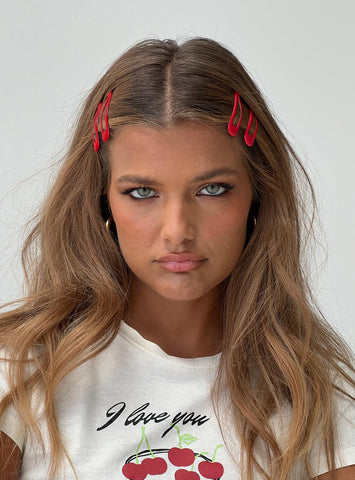
The Say My Name Hair Clip in Yellow Tort is the combination I didn’t know I needed to think about until I saw it. Yellow and tortoiseshell shouldn’t obviously work together — one is warm and assertive, the other is warm and classic — but stacked they create something that reads as both retro and contemporary simultaneously. It’s the kind of color story you see in vintage Italian design: unlikely warmth layered on warmth in a way that feels rich rather than overwhelming. The personality it communicates is specific: someone who has style opinions, who notices color, who isn’t defaulting to neutral accessories because neutrals are easier. It’s an understated statement piece, which is a harder thing to pull off than it sounds.
👉 Say My Name Hair Clip in Yellow Tort

And then there’s the scrunchie. I want to close with it because scrunchies are consistently underestimated as a styling tool — people tend to reach for them as a comfort choice rather than a considered one, which is a waste of what they can do. The Fancy That Textured Scrunchie in Blue Check is a different proposition from a plain scrunchie in a few meaningful ways. The texture means it holds its shape and sits with genuine volume on the ponytail, which reads as more intentional than a flat or limp one. The check pattern adds visual interest that a solid color doesn’t — it becomes a pattern piece you’re working into your outfit rather than just a hair tie you grabbed off the bathroom counter. Blue check in particular has crossover appeal because it reads as both preppy and casual depending on context: alongside a white shirt it goes collegiate; alongside a slouchy knit it goes off-duty; against a blazer it does something genuinely unexpected. On thick or curly hair, the scrunchie sits with more volume and puff, which can look beautiful at the nape of the neck in a low pony. On fine hair it can overwhelm if worn too high, but at the base of a mid-height ponytail it sits just right. The sweet spot placement for most hair types is low — at the nape or just above — where the scrunchie becomes a finishing detail rather than the structural element doing all the work.
👉 Fancy That Textured Scrunchie in Blue Check

The thing I keep coming back to when I think about hair accessories is how completely low-stakes they are as an experiment. You can try a flower clip for a week and decide it’s not you. You can go back to nothing, or back to a plain black elastic, or forward to a gold claw clip, without any of it requiring commitment or cost. That reversibility is what makes accessories the best possible testing ground for a different version of your style. You don’t have to build a whole new wardrobe to figure out whether you’re someone who wears floral things or statement things or minimal metallic things — you try one clip for a Tuesday, see how it feels, and go from there.
Most fashion choices close options. A major haircut, a bold clothing purchase, a new wardrobe direction — these take time to course-correct. A hair clip does the opposite. It opens options every morning, requires nothing from you the day after, and costs almost nothing to try. That might be the best argument for taking them more seriously than most people do.
The information in this post is based on personal research and experience and is intended for educational purposes only. It is not a substitute for professional medical or dermatological advice, diagnosis, or treatment. Always consult a qualified healthcare provider before making changes to your skincare routine or health practices, especially if you have a medical condition or sensitivity.
