
This post contains affiliate links. If you click a link and make a purchase, I may earn a small commission at no extra cost to you. I only recommend products I genuinely believe in. Thank you for supporting Amoria Style!
Most heat damage advice skips the part that would actually make you change your habits: what’s happening inside the hair shaft when you run a flat iron over it. Once you understand the mechanism, the “always use heat protectant” instruction stops feeling like generic advice and starts making sense in a way that changes how you actually use your tools.
Here’s the full picture — what heat does, where the line between temporary and permanent damage is, and what protection actually works versus what’s marketing.
What Your Hair Is Made Of
Hair is primarily keratin — a fibrous protein made up of amino acid chains. Those chains are held together by three types of bonds: hydrogen bonds, salt bonds, and disulfide bonds. Each responds differently to heat, and understanding which bond does what explains almost everything about how styling works and why damage happens.
Hydrogen bonds are weak and temporary. They break easily with water or heat and reform as hair cools or dries. This is why wet hair is more malleable than dry hair, and why blowdrying into a shape holds that shape — you’re breaking hydrogen bonds with heat and setting them in a new position as the hair cools. This process is completely reversible. The next time your hair gets wet, the hydrogen bonds break and reform again in their natural position.
Salt bonds are slightly stronger than hydrogen bonds and respond to pH rather than heat. They’re less relevant to heat styling specifically.
Disulfide bonds are strong, permanent covalent bonds between sulfur atoms in the keratin chains. They determine your hair’s natural texture — the pattern of disulfide bonds is what makes hair straight, wavy, or curly. Breaking disulfide bonds requires either very high heat or chemical processes (like perms or relaxers). When they break from heat damage, they don’t reform correctly. This is permanent damage.

What Temperature Does to Each Layer
Hair has three layers: the cuticle (outer protective scales), the cortex (the structural middle layer where keratin bonds live), and the medulla (the inner core, not present in all hair types).
Below 150°C (300°F): Heat primarily affects hydrogen bonds — the temporary, reversible ones. Blowdrying at moderate heat, gentle curling, light straightening. Hair can be restyled with water and will return to its natural texture. Minimal structural damage with appropriate technique.
150°C to 180°C (300°F to 356°F): The cuticle begins to lift and show stress. Repeated exposure starts to erode the cuticle’s surface, making hair look dull and feel rough. Some hydrogen bond changes become harder to reverse. This is the range where most everyday heat styling happens and where cumulative damage begins.
180°C to 210°C (356°F to 410°F): Significant cuticle damage. The cortex begins to be affected. At the higher end of this range, disulfide bonds start to break — the permanent damage threshold. Hair protein begins to degrade. This is where a single session can cause visible, lasting damage if held too long in one section.
Above 210°C (410°F): Severe protein degradation. Disulfide bonds break significantly. Hair becomes brittle, loses elasticity, and breaks. The damage at this temperature is irreversible. A flat iron set to maximum and held on a section for more than a few seconds in this range can cause damage that no treatment will fully repair.
The Difference Between Temporary and Permanent Damage
This is the distinction most heat damage content blurs, and it matters practically.
Temporary damage looks like: frizz, dryness, dullness, hair that doesn’t hold its natural texture as well after washing. It feels rough because the cuticle is raised or slightly eroded, but the cortex is intact. Deep conditioning, protein treatments, and simply giving your hair a break from heat will improve it significantly. The underlying structure is fine.
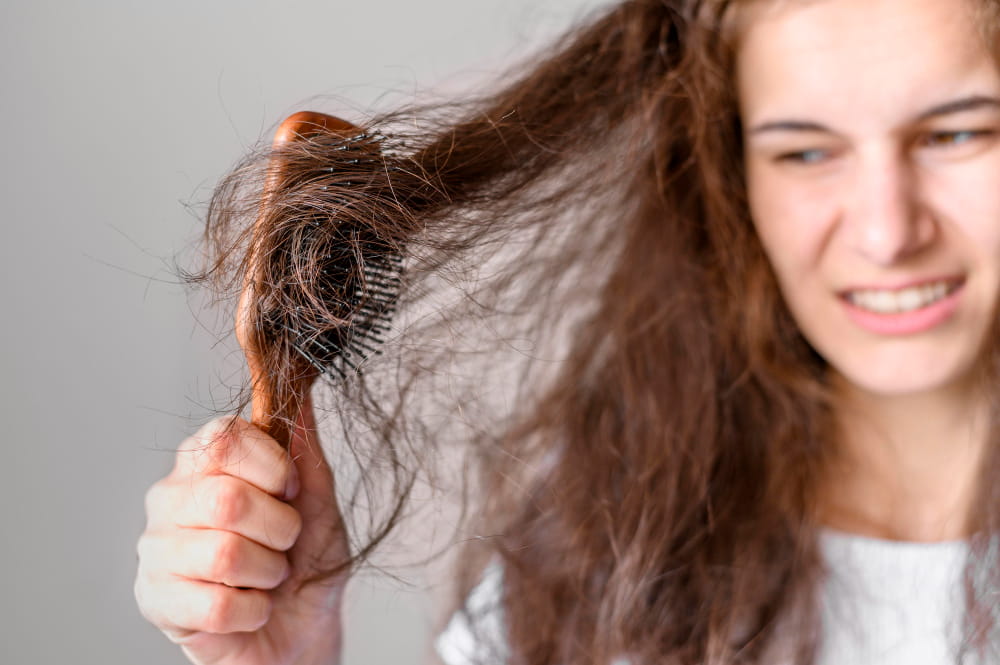
Permanent damage looks like: hair that has completely lost its natural curl or wave pattern and won’t return to it even after washing, extreme brittleness that results in breakage rather than stretch when pulled, sections that feel completely different in texture from the rest of the hair — glassy, straw-like, or limp in a way that doesn’t respond to any treatment.
The key test: wet your hair and let it air dry without touching it. If your natural texture returns, the damage is in the cuticle and is manageable. If sections of hair dry straight when they were previously wavy or curly, or vice versa, the disulfide bonds in those sections have been altered — that’s permanent, and the only solution is cutting those sections off and growing new hair.
What Heat Protectant Actually Does
Heat protectant is not a shield that stops heat from reaching your hair. It doesn’t create a barrier that keeps 450°F from affecting your strands. That’s not how the chemistry works.
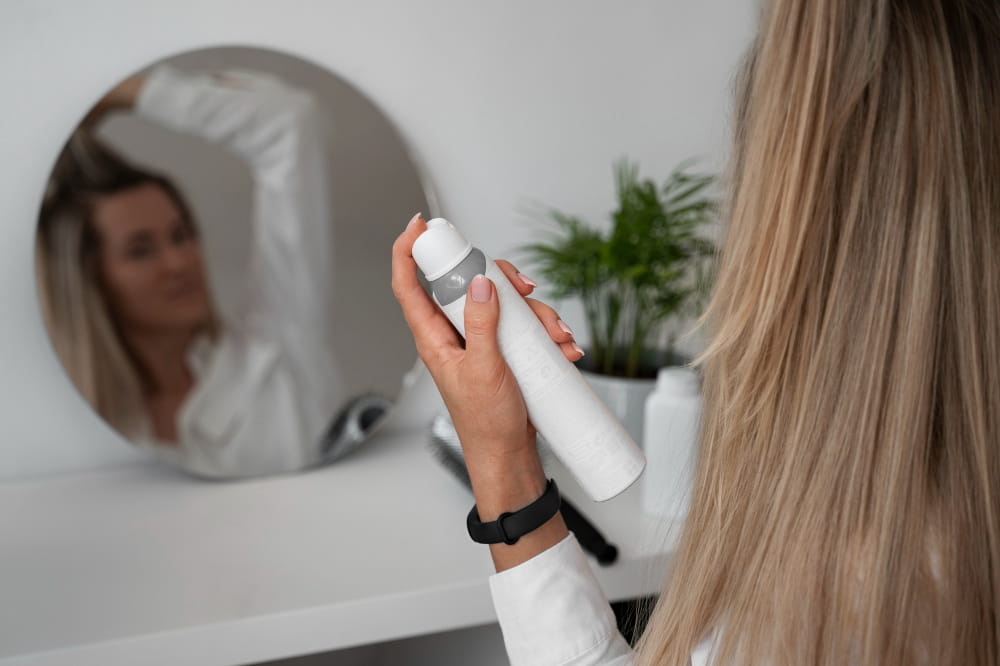
What heat protectants actually do: they coat the hair shaft with ingredients — typically silicones, polymers, or certain proteins — that distribute heat more evenly across the hair surface rather than allowing it to concentrate in specific points. They also reduce the friction between the tool and the hair shaft, which decreases mechanical damage from the tool passing over the hair. Some formulations add temporary moisture that reduces the brittleness caused by heat exposure.
The practical implication: heat protectant meaningfully reduces damage in the 150°C to 180°C range where most styling happens. It does not meaningfully protect hair at temperatures above 200°C — at that point, the heat is simply too high for a coating to compensate. If you’re using your tool at maximum heat and relying on protectant to keep your hair safe, you’re misunderstanding what the product can do.
What actually matters more than which heat protectant you use:
The temperature setting is the single most important variable. Most hair types don’t need above 180°C for effective styling. Fine or damaged hair needs less — 150°C to 160°C is usually sufficient. Only thick, coarse, or very resistant hair genuinely benefits from temperatures above 185°C. If you’ve been using 230°C because that’s the maximum and it works faster — you’re trading speed for cumulative structural damage.
How to Actually Reduce Heat Damage
Lower the temperature first. Before anything else. Drop your flat iron or curling iron to 170°C to 180°C and see if it still works for your hair. For most people it will — it just takes slightly more passes or slightly more time. That trade-off is worth it.
One pass, not multiple. Each pass of a hot tool over the same section multiplies the heat exposure. Proper sectioning — working in thin, even sections rather than large chunks — means one pass does the work that multiple passes would do on a thick section. One pass at 180°C is significantly less damaging than three passes at the same temperature.
Never use heat on wet hair. Water inside the hair shaft reaches boiling point at 100°C — well below the temperature of any heat styling tool. Steam bubbles form inside the cortex and cause damage from the inside out. This is sometimes called “bubble hair” and it’s one of the more severe forms of heat damage. Hair needs to be completely dry before any direct heat tool is applied. (source)
Give your hair recovery days. Hair doesn’t repair itself during styling — recovery happens between sessions, particularly when hair is hydrated and given time without mechanical or thermal stress. Heat styling every day doesn’t give the cuticle time to settle. Two or three days between heat sessions is enough to make a meaningful difference to cumulative damage over time.
Protein treatments for damaged hair, moisture for healthy hair. Heat damage degrades keratin protein in the cortex. Protein treatments temporarily fill gaps in damaged hair structure and improve strength and elasticity. However, protein on already-healthy hair can make it stiff and brittle — the treatment needs to match the condition. If your hair feels weak, stretchy, and breaks easily, protein. If it feels dry but strong, moisture.
The Temperature Guide by Hair Type
Fine or already-damaged hair: 130°C to 160°C maximum. Fine hair has a smaller diameter which means heat penetrates to the cortex faster and at lower temperatures than thick hair.
Normal, medium-thickness hair: 160°C to 180°C. The range where effective styling and acceptable damage risk balance for most people.
Thick, coarse, or resistant hair: 180°C to 200°C. Above 200°C is rarely necessary and increases damage risk significantly even for thick hair.
Colour-treated hair: Drop 10°C to 20°C below whatever you’d use on uncoloured hair of the same thickness. The chemical process of colouring disrupts disulfide bonds and raises cuticle scales, making colour-treated hair significantly more vulnerable to heat damage than its thickness alone would suggest.
One Thing Worth Knowing
The hair you can see is dead tissue. It cannot repair itself the way skin does — there are no living cells in the hair shaft to regenerate damaged protein or rebuild broken bonds. Every styling decision is permanent in the sense that the hair you have now is the hair you have until it grows out and is cut off.
That’s not an argument for never using heat. It’s an argument for using it at the right temperature, with proper preparation, and with realistic expectations about what heat protectant can and can’t do. The tools aren’t the problem — the settings and habits are. Check what temperature you’re actually styling at tonight and see where it falls on the scale above.
The information in this post is based on personal research and experience and is intended for educational purposes only. It is not a substitute for professional medical or dermatological advice, diagnosis, or treatment. Always consult a qualified healthcare provider before making changes to your skincare routine or health practices, especially if you have a medical condition or sensitivity.
